Everything your agents need, from first design to years in production
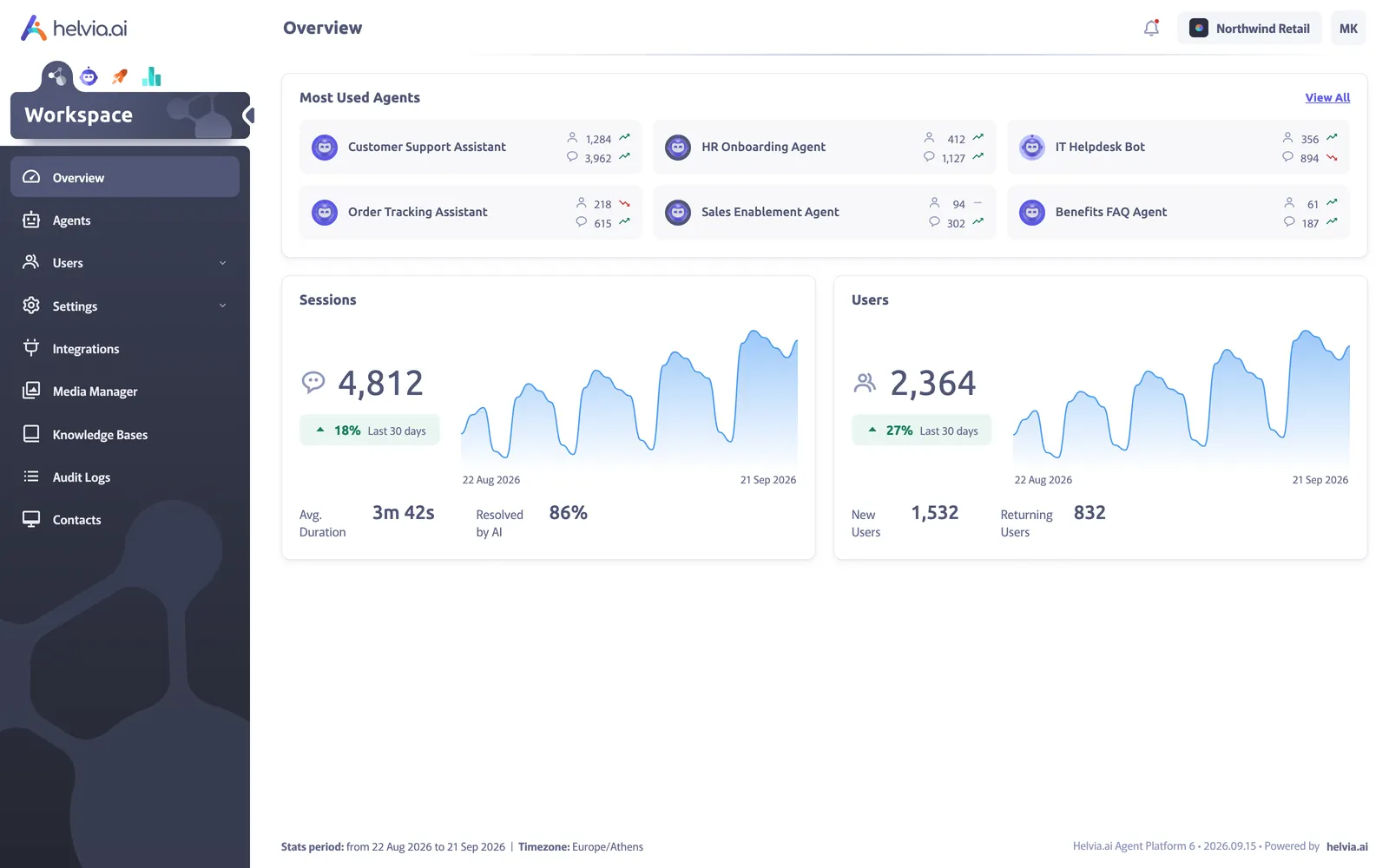
Design, test, deploy and monitor agents in one place. Trace their actions, evaluate their performance and keep improving them as your business evolves.
Platform tools
AI is reshaping how businesses operate. Helvia.ai has ten years of experience putting AI to work in enterprises. We work with your teams to build, deploy and run AI agents that become part of how you operate: for your customers, your people, your processes and your code.
From energy and aviation to insurance, manufacturing, staffing, gaming, HR software and the public sector, we deliver practical AI solutions on Helvia.ai infrastructure or within your own environment.
For your customers, your people and the processes that connect them.
AI agents for customer service, sales and onboarding. They answer from your knowledge, take action in your systems and bring in a person when human judgment matters.
Agents that run business processes from trigger to completion. They read documents, make decisions and act across your systems—with their own identity, permissions and a complete log of every action.
A personal AI co-worker that brings together company knowledge and the systems each employee needs. From answering questions to preparing a daily brief, it helps people get to the right information and move work forward.
Agent teams that turn tickets into tested, reviewable code. They plan the work, write and test code, and open a preview for your developers to review and approve at every step.
The technology to build, run and work with AI agents.Build and govern AI agents on our platform. Give every employee an AI co-worker. Put agent teams to work alongside your developers.
Design, test, deploy and monitor agents in one place. Trace their actions, evaluate their performance and keep improving them as your business evolves.
Platform tools
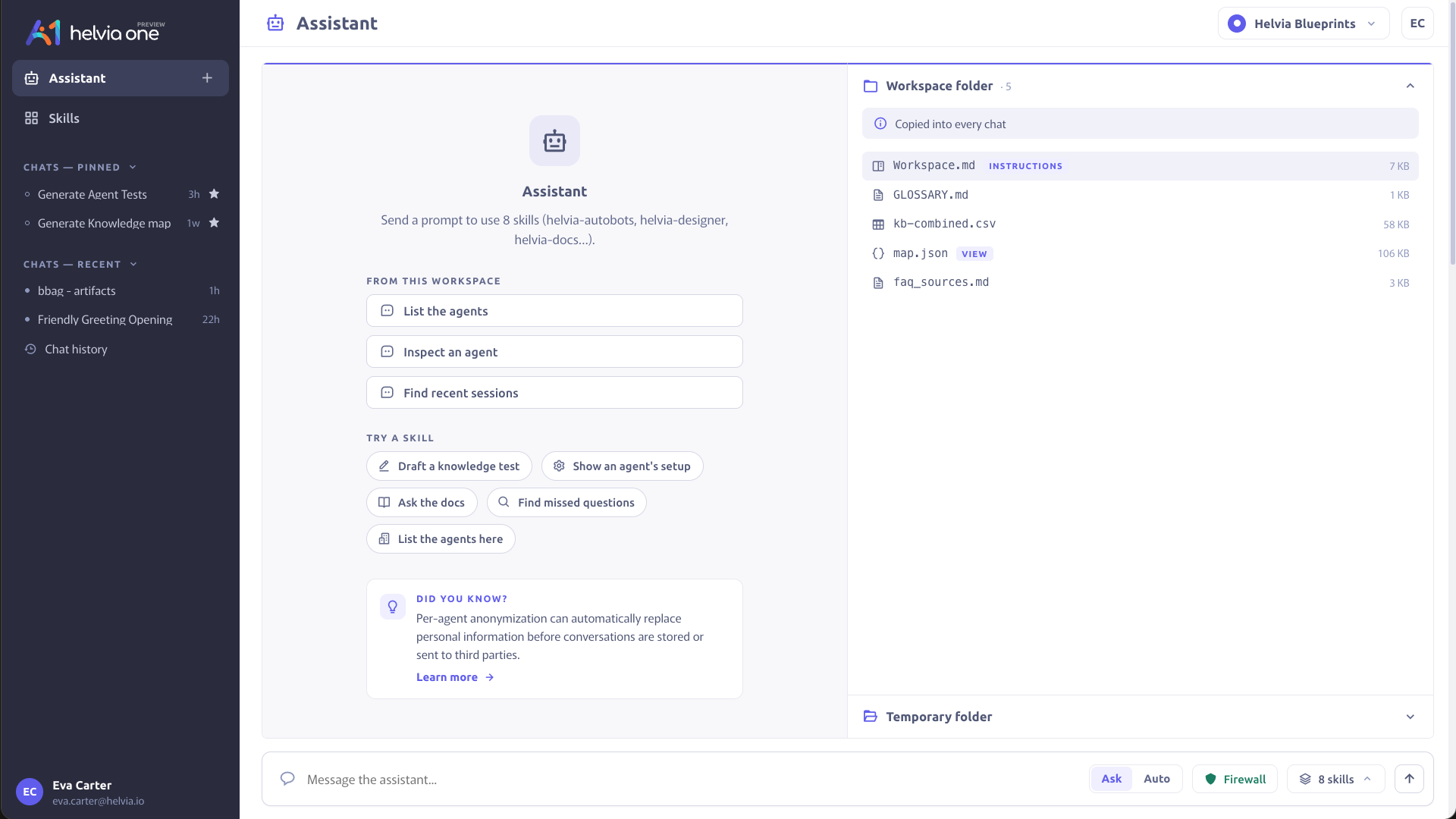
Give every employee an AI co-worker grounded in company knowledge, with a personal workspace and memory. Department extensions connect the tools and systems each team needs. Enterprise identity and usage controls help IT manage access, cost and adoption.
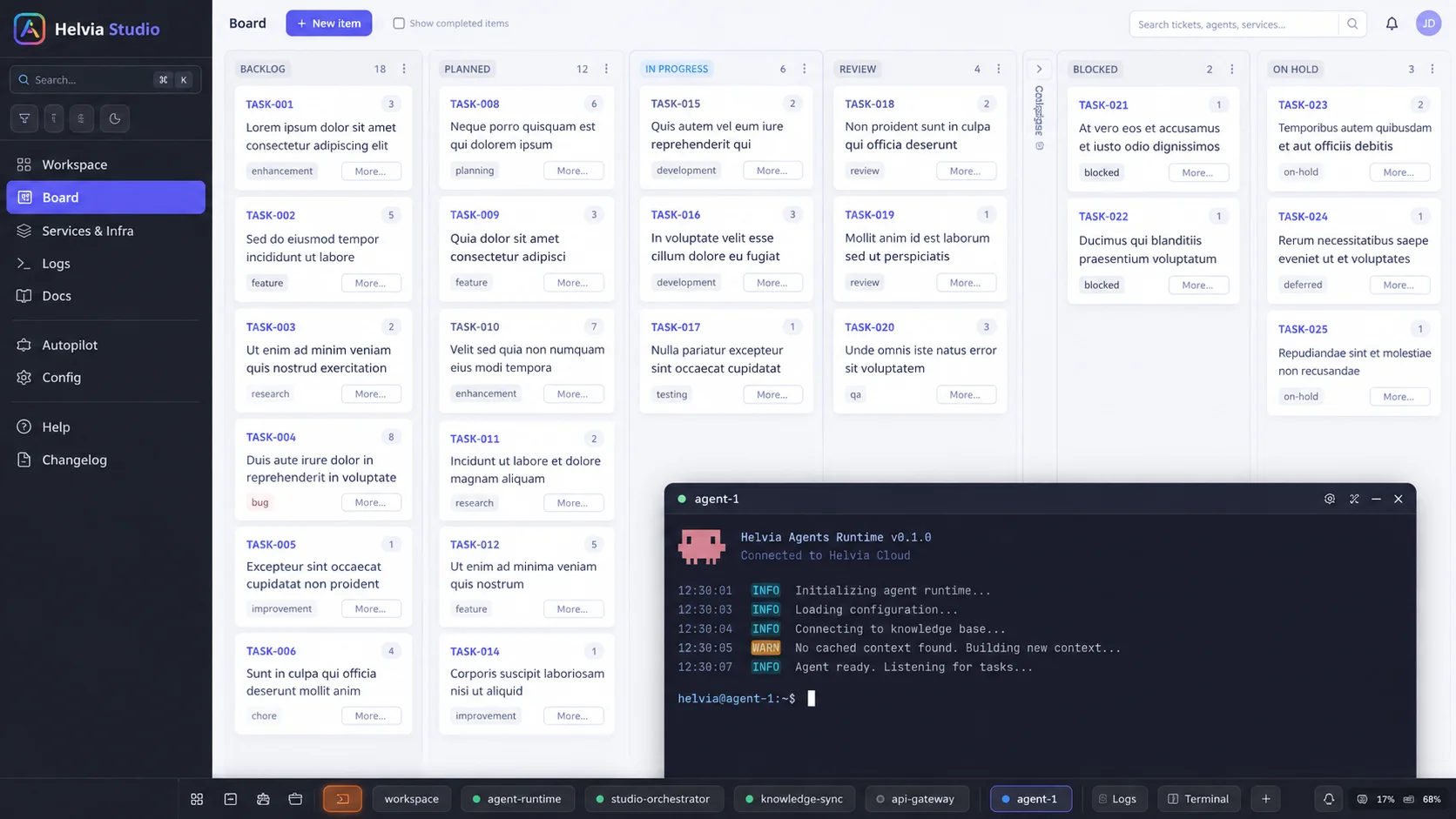
Software agents turn tickets into tested, reviewable code. They plan the work, write and test the code, and open a preview. Your developers review and approve each step, so the code stays theirs.
From the first AI use case to company-wide adoption. We bring business and AI expertise together to identify the right opportunities, deliver measurable results and scale what works across your organization.
Start
Find where AI delivers the most value.
We work with your business and IT teams to identify high-value opportunities, assess feasibility and build a prioritized roadmap for implementation.
Build
AI assistants for your customers.Deploy AI assistants for customer service, sales and onboarding across your website and messaging channels, with voice and avatar experiences where they add value. They answer using your knowledge, take action in connected systems and hand over to your team when human support is needed.
Give every employee an AI co-worker.Roll out Helvia One department by department, giving employees AI co-workers configured for their roles, workflows and business needs. Start with one team, measure adoption and productivity, then expand across the organisation.
Agents that run your processes.Automate multi-step business processes with AI agents that work in the background, triggered by events or schedules. They process documents, make decisions and act across connected systems, operating within permissions and controls defined by your team.
Run
Keep your AI performing in production.
We monitor, test and improve your AI agents after launch. Our operational tools help identify issues, uncover gaps in performance and keep your agents aligned with your evolving business needs.
From the first pilot to lasting impact. A practical, iterative approach helps you move from identifying opportunities to deploying AI, measuring results and scaling with confidence.
Six weeks with your business and IT teams to identify opportunities, prioritize use cases and scope your first pilot.
Get your first solution into practice, measure its impact and establish what is needed for wider adoption. Target: first results within 90 days.
Monitor performance, address issues and continuously improve your live AI solutions.
Extend successful solutions to more teams, applying what you've learned at every stage.
We design, build and deploy AI solutions, then manage their day-to-day operation and continuous improvement as your business evolves.
We provide the tools, foundations and training your people need to operate, manage and extend AI solutions independently.
AI agents for B2B sales
Telecommunications
A background agent that qualifies B2B leads and prepares sales lists for a major telecom operator.
AI co-workers for IT architects
Energy
AI co-workers that help an energy company's IT architects draft and review architecture documents.
AI-powered public services
Public sector
A citizen assistant, a staff assistant and a talking avatar supporting a national public-sector help centre.
Already using Claude, Gemini or ChatGPT? We help you put them to work across your organization, alongside Helvia's own AI products.
We combine proprietary products, a decade of experience building AI for production, and research into the technologies shaping what's next. The result is an enterprise AI stack designed to work with your models, infrastructure and systems—not lock you into ours.
Our processes are audited against international standards, so your teams can deploy AI with confidence.

Information security management, covering how we protect your data, systems and infrastructure.

Quality management, ensuring consistent delivery and continuous improvement across projects.

Personal data is processed lawfully, transparently and only for the purposes agreed with you.

Accessible interfaces, so every end-user can interact with your AI agents.
We start with the business outcome, make practical decisions and concentrate our effort on getting solutions working reliably in production.
Ten years of putting AI to work in enterprises, with our own technology and hands-on engineering.
AI is reshaping how businesses operate, how people work and how software is built. Turning that potential into lasting business value takes more than promising technology. It takes deep expertise, sound engineering and an understanding of how enterprises work.
Helvia.ai brings these capabilities together. With a decade of experience across AI and software engineering, we combine proprietary technology with hands-on expertise to help enterprises address complex challenges and put AI to work in meaningful ways.
We believe the best solutions come from bringing technology and business needs closer together. That's why we stay involved beyond the initial implementation, taking responsibility for the engineering, integration and ongoing operation needed to make AI work in practice.
We develop our own products and platforms for building, operating and working with AI. This allows us to combine product innovation with practical engineering experience, using our technology to accelerate delivery and create solutions for real business needs.
Realizing the value of AI starts with understanding where it can make a difference. We work at the intersection of business and technology, helping enterprises identify opportunities, shape solutions and turn them into capabilities that deliver lasting value.
Tell us about your team and what you want AI agents to do. We'll get back to you to set up a first conversation.
Join Helvia.ai and help shape how enterprises put AI agents to work.
{{ v.text }}
Papers, competitions and technical write-ups from the team building Helvia’s AI, on LLM evaluation, cost-efficient models and NLP for Greek.
No posts under this topic on this page yet. See all on helvia.ai
Publications
Published at leading venues in NLP, finance AI and human-computer interaction.
Say goodbye to costly methods like LLM-as-a-Judge and outdated metrics like ROUGE or BLEURT. We simplify RAG evaluation using GRACE (Grounded Retrieval-Augmented Citation Evaluation).
GRACE helps us evaluate LLMs effectively and affordably using simple classification metrics like accuracy, just by comparing the LLM-selected citations with the annotated citations of an LLM-generated answer. To enable it, we follow a specific RAG architecture with specific Knowledge Base preprocessing, which we call Grounded RAG with citations (Grounded RAG+C).
Retrieval-Augmented Generation (RAG) is the go-to approach for enabling LLMs to answer questions on proprietary documents, such as business knowledge bases. Behind every RAG system, one question matters most: did we provide the correct answer to the user?
One approach is an LLM-as-a-Judge, asking a different LLM to score responses on relevance or groundedness. It is promising, but expensive to scale. Traditional NLG metrics like ROUGE or BLEURT are limited too: two answers with the same meaning but different lengths score poorly.
If the correct article is cited, the LLM has likely given the correct answer.
Grounded RAG+C builds on standard RAG with one key improvement: the LLM is prompted to ground its response on a single retrieved article and include an inline citation. We then check whether the cited article matches the predefined correct article for the query: a hit or a miss.

All we need to do is:
For our internal HR support chatbot we compiled over ~700 hard real-world user queries, each linked to the self-contained article it should match. Leading proprietary models scored highest, while smaller open-weight models failed to answer around half of the questions.
Takeaway
GRACE turns RAG evaluation into a classification task. With self-contained articles and single-citation answers, you can compare LLMs at low cost using metrics like accuracy. See the full results on the GRACE leaderboard.
{{ post.excerpt }}
Mockup: only the featured write-up has body copy. Read this one on helvia.ai
Views from our team on AI agents, adoption and the work of putting AI into production, plus company news.
In a wide-ranging interview with Insider.gr, Dimitris Balaouras, co-founder of Helvia.ai, argues that 2026 is the year AI stops being a side experiment and becomes part of how a company actually runs. His one-line answer, if you only keep one: the quality of your AI implementation is directly tied to the quality of your data.
The original interview, conducted by Niki Papazoglou, was published in Greek on Insider.gr. We’ve translated the full conversation into English below.
The Greek market has moved past the phase of AI demos. What’s needed now are companies that already operate as AI-native — and that’s the real threshold of 2026.
Over the last two years we saw thousands of pilots and experimental chatbots. That phase was necessary, so we could all understand what the technology can and can’t do. At Helvia.ai we see the shift in the conversation with leadership clearly: today they don’t ask us “what can AI do.” They ask us “how do we govern it, how do we control it, how do we put it into production.”
The difference between experimentation and business value isn’t technological. It’s architectural.
When you treat AI as one more project, you stay in experimentation. When you treat it as a new operating layer for the business, you gain a real competitive advantage.
It’s not a dilemma. The implementation has to be incremental. The design, though, has to be holistic.
For us, the right approach has three stages:
AI isn’t a project roadmap — it’s a transformation roadmap.
In most cases where an AI implementation didn’t deliver what was expected, the cause wasn’t the technology. It was the data — scattered across different systems, inconsistent, locked in silos. So before you go hunting for the perfect AI tool, it’s worth spending time on the foundations: getting your data organized, reliable, and accessible to your teams.
Takeaway
In 2026, AI is an operating decision, not a technology purchase. Buy where you don’t differentiate, build where you do, fix your data first, and design for people and AI working side by side. For most organizations, the real risk is no longer moving too fast — it’s standing still.

{{ post.excerpt }}
Mockup: only the featured article has full body copy. Read this one on helvia.ai
{{ doc.lede }}
Effective {{ doc.date }}
{{ bl.addr }}